

Introduction: Why the Future of Transportation Technology Matters
The Future of Transportation Technology goes beyond simply creating faster vehicles; it involves reimagining how billions of people move around the world. Transportation has consistently influenced human progress, from the invention of the wheel to today’s electric cars and AI-driven trains. But in 2025, the sector is undergoing a transformation driven by sustainability, digital innovation, and global connectivity. Growing urban populations, climate change, and energy challenges require innovative solutions that prioritize sustainability and the well-being of our planet.
Governments, industries, and innovators are investing billions into electric mobility, autonomous systems, renewable energy, and even space travel. These advancements aim to enhance speed while also fostering safer, cleaner, and more sustainable transportation systems.The future of transportation technology lies at the crossroads of innovation and necessity, offering a vision of travel that is efficient, environmentally friendly, and accessible to everyone.
Historical Evolution of Transportation
Ancient and Medieval Innovations
The evolution of Future Transportation Technology began thousands of years ago when humans used simple tools like rafts, carts, and domesticated animals for mobility. The invention of the wheel was a pivotal moment, making farming, trade, and long-distance travel much easier. Civilizations like the Romans developed extensive road networks, establishing the groundwork for organized transportation. Canals and sailing ships further connected nations, fostering early globalization. These initial innovations influenced cultural exchanges, economies, and migration patterns, reflecting how transportation will continue to transform our world in the future.
Industrial Revolution and Modernization
The Industrial Revolution introduced a wave of transportation innovations that forever changed societies. Steam-powered trains and ships reduced travel time from months to days, revolutionizing trade and exploration. The creation of the car put transportation directly in the hands of everyday individuals, creating new opportunities for both employment and recreation. Aviation breakthroughs in the early 20th century connected continents in hours, creating a sense of global unity.This time was an important step for the Future of Transportation Technology. It showed how new technology could change how people interact, the economy, and daily life.
Digital Age and Smart Navigation
The late 20th century ushered in the digital age, where transportation evolved beyond vehicles into intelligent systems. The introduction of GPS, electronic tolls, ride-hailing apps, and real-time navigation revolutionized mobility management. Cities started using automated ticketing systems and smart metros to reduce congestion.This era has shown us that the Future of transportation goes beyond physical vehicles; it encompasses data-driven ecosystems as well. The Future of Transportation Technology leverages this digital foundation by incorporating AI, IoT, and connectivity to ensure smarter and safer journeys for everyone.
The Present State Future of Transportation technology in 2025
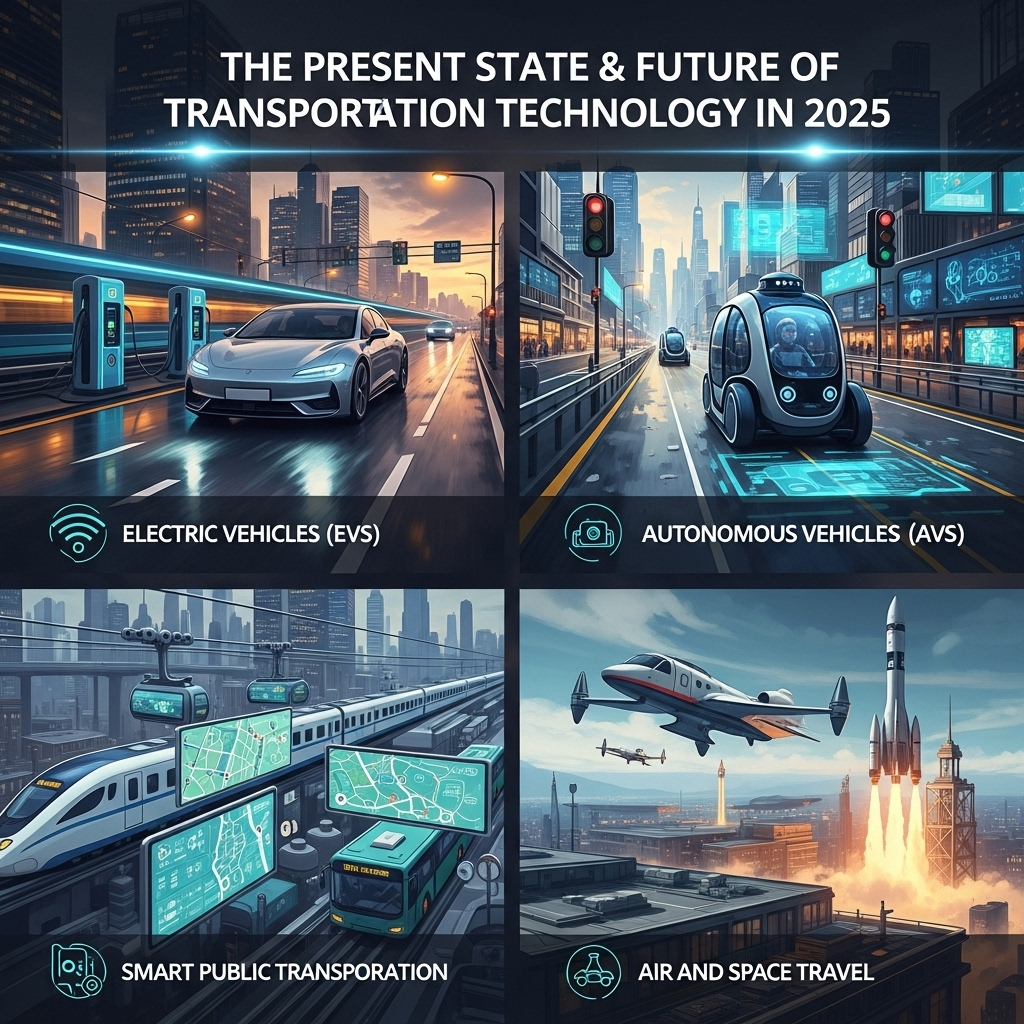
Electric Vehicles (EVs)
The rise of electric vehicles marks the most visible change in today’s transport landscape. In 2025, EVs represent over one-third of global car sales, with nations like Norway and China leading adoption. Companies like Tesla, BYD, and Volkswagen have made EVs accessible for middle-class families. Advances in battery technology, such as solid-state designs, have significantly increased range while reducing charging times. Charging infrastructure is rapidly expanding worldwide, with governments offering subsidies for green mobility. The Future of Transportation Technology relies significantly on electric vehicles (EVs), as they tackle climate issues while meeting the growing demand for efficient mobility.
Autonomous Vehicles (AVs)
Autonomous vehicles are no longer science fiction—they are operating on city roads in pilot programs across the U.S., China, and Europe. Companies like Waymo, Uber, and Tesla have made significant progress in AI-driven mobility. Autonomous delivery trucks are transforming logistics, while robo-taxis are beginning to reshape urban transportation. These vehicles promise fewer accidents, as AI reduces human error, which is responsible for most crashes. However, challenges such as regulation, cybersecurity, and ethical dilemmas remain. The Future of Transportation Technology envisions a world where self-driving cars and trucks move seamlessly, improving safety and efficiency.
Smart Public Transportation
Public transportation is evolving into an intelligent, eco-friendly, and integrated system. Cities such as Singapore, Seoul, and Amsterdam are leading the way with AI-powered traffic management, electric bus fleets, and cashless payment systems. Real-time data allows governments to adjust routes and reduce congestion. Digital ticketing and smart metro systems create seamless passenger experiences. The integration of bicycles, car-sharing, and mass transit options also makes urban life more sustainable.
Air and Space Travel
The aviation sector is entering a new era with supersonic jets and commercial space exploration. Supersonic aircraft like Boom Supersonic promise to cut transatlantic travel times in half, making global connectivity faster than ever. At the same time, companies like SpaceX, Blue Origin, and Virgin Galactic are testing space tourism, opening possibilities beyond Earth. While still expensive, these technologies will eventually redefine international travel and tourism.
Key Innovations Driving the Future of Transportation Technology
Electric and Hydrogen-Powered Vehicles
The shift from fossil fuels to clean energy is one of the most defining aspects of modern transport. Electric vehicles dominate consumer adoption, but hydrogen-powered vehicles are rising in heavy-duty transport such as trucks, buses, and shipping. Hydrogen fuel cells offer longer ranges and faster refueling, making them essential for long-haul mobility. This combination of EVs and hydrogen represents a balanced and scalable approach. The Future of Transportation Technology will rely on these green alternatives to cut emissions and meet international climate goals.
Autonomous Mobility at Scale
Self-driving technology will expand beyond cars to buses, delivery vans, and even flying vehicles. By 2035, experts predict that autonomous fleets will dominate urban transport. AI will allow vehicles to communicate with each other, improving safety and reducing congestion. This will free humans from driving and transform travel into a time for work, rest, or entertainment. The Future of Transportation Technology depends on AI mobility to reduce accidents, lower emissions, and create efficient traffic ecosystems that support smart cities.
Hyperloop and High-Speed Rail
The hyperloop concept, introduced by Elon Musk, is rapidly gaining traction with global projects in development. Using vacuum tubes and magnetic levitation, hyperloop systems promise speeds faster than airplanes with minimal environmental impact. At the same time, high-speed rail networks in countries like China, Japan, and France are expanding rapidly. Hyperloop and advanced rail systems are key for intercity travel in the Future of Transportation Technology. They reduce the need for short flights and offer sustainable options for millions of travelers.
Urban Air Mobility (Flying Cars & Air Taxis)
Urban air mobility is one of the most futuristic trends, with companies like Joby Aviation, Volocopter, and Hyundai testing electric vertical takeoff and landing (eVTOL) aircraft. These air taxis aim to bypass congested roads, offering fast, eco-friendly travel within cities. While still in early testing phases, eVTOLs could be mainstream by 2035, reshaping urban mobility. The Future of Transportation Technology includes flying cars and air taxis as integral solutions to traffic congestion, offering cleaner and faster alternatives for urban transport.
AI and Internet of Things (IoT) in Transportation
AI and IoT are transforming transportation into a smart, data-driven ecosystem. Cars now communicate with infrastructure through vehicle-to-everything (V2X) technology. Smart traffic lights powered by AI adjust based on real-time data to reduce congestion. IoT sensors monitor vehicle health, ensuring predictive maintenance that prevents accidents. The combination of AI and IoT will play a crucial role in the Future of Transportation Technology, enhancing travel efficiency, reliability, and sustainability
The Role of Sustainability in Future of Transportation Technology
Reducing Carbon Emissions
A major driver behind the Future of Transportation Technology is the urgent need to reduce global carbon emissions. Transportation contributes nearly one-quarter of greenhouse gases worldwide, with road vehicles being the largest culprits. Electric vehicles (EVs), hydrogen fuel cells, and renewable-powered systems are leading solutions to cut emissions drastically. Countries are setting ambitious goals, such as banning fossil fuel cars by 2035 in parts of Europe. Beyond vehicles, entire cities are redesigning public transportation networks to reduce car dependency.
Circular Economy in Vehicle Production
Sustainability in transportation extends beyond fuel—it includes how vehicles are made, used, and recycled. Automakers are investing in a circular economy, where materials are reused rather than wasted. EV batteries, for instance, are being repurposed for renewable energy storage after their life in vehicles ends. Lightweight materials like carbon composites and biodegradable plastics reduce both emissions and waste. Incorporating sustainability into manufacturing methods will enable the Future of Transportation Technology to minimize environmental impact, lower expenses, and foster innovation while safeguarding our health.
Greener Public Transportation
Public transportation is one of the most effective ways to reduce emissions. Electric buses, trams, and metro systems are replacing diesel fleets in many major cities. Governments are promoting car-free zones, encouraging people to walk, bike, or use eco-friendly transport options. Shared mobility services such as carpooling apps and bike rentals are reducing congestion and emissions.
Challenges in the Future of Transportation Technology
Infrastructure Limitations
While innovation is exciting, infrastructure remains a massive hurdle. For example, millions of EV charging stations are needed worldwide to support the shift from fossil fuels. Similarly, building hyperloop routes requires enormous investment and political collaboration. Urban air taxis will demand entirely new air-traffic management systems. Without robust infrastructure, even the most advanced vehicles cannot achieve mass adoption. Addressing this challenge is crucial to the Future of Transportation Technology, as infrastructure acts as the backbone for enabling large-scale transformation.
Cybersecurity and Safety
As transportation becomes more digital, cybersecurity risks grow. Autonomous vehicles, smart traffic lights, and connected systems can be vulnerable to hacking. A single cyberattack could cause massive disruptions, accidents, or data breaches. Safety also raises ethical questions—such as how AI should respond in unavoidable accident scenarios. Ensuring cybersecurity and ethical AI design is central to building trust. The Future of Transportation Technology will depend heavily on cybersecurity advancements to maintain safe, reliable, and trustworthy systems for both individuals and businesses.
Economic and Social Barriers
While rich nations adopt advanced transportation quickly, many developing countries struggle with affordability and infrastructure gaps. EVs remain expensive for lower-income groups, and autonomous vehicles may initially serve only wealthy populations. This could widen inequalities between tech-rich and tech-poor societies. Bridging this gap will require government subsidies, low-cost innovations, and inclusive planning. The Future of Transportation Technology must ensure equal access to mobility, empowering all communities regardless of income or geography.
Environmental Trade-Offs
Ironically, even sustainable solutions have environmental costs. Mining lithium and cobalt for EV batteries raises concerns about pollution and labor practices. Manufacturing eVTOLs and high-speed trains requires significant resources. Noise pollution from air taxis could disrupt urban life. These trade-offs mean that while transportation technology is moving toward sustainability, it must balance innovation with responsibility. AAddressing such trade-offs will define how successful the Future of Transportation Technology is in achieving its eco-friendly promises.
Future Outlook: What Will Transportation Look Like in 2050?
Electric and Hydrogen Dominance
By 2050, experts predict that 90% of vehicles will run on electric or hydrogen power. EVs will dominate urban mobility due to their efficiency and low cost, while hydrogen will power heavy-duty trucks, ships, and planes. Charging and refueling stations will be as common as today’s gas stations, making green energy the global standard. This transition highlights how the Future of Transportation Technology is reshaping mobility into a sustainable and universally accessible service.
Hyperloop and Smart Rail Networks
Hyperloop technology, though in its early stages today, is expected to be operational in multiple regions by 2050. These high-speed systems will make city-to-city travel faster than flights while being energy-efficient. At the same time, existing high-speed rail networks will expand globally, reducing dependency on short-haul flights. Together, these systems will become a sustainable backbone of intercity travel. The Future of Transportation Technology envisions a world where commuting between cities is faster, greener, and more affordable than ever before.
Flying Taxis and Urban Air Mobility
By 2050, urban skylines may be filled with flying taxis that complement ground transport. eVTOL aircraft will enable quick connections across congested cities, reducing traffic jams dramatically. Dedicated aerial highways and vertical landing pads will integrate seamlessly into urban infrastructure. This will change perceptions of mobility, focusing on air-based solutions to enhance efficiency in crowded cities.
Space Travel and Beyond Earth Mobility
Commercial space travel will likely become mainstream by 2050. Companies such as SpaceX are already planning missions to Mars, and by mid-century, humans may have regular trips to the Moon. Space tourism, once a fantasy, will be available to wealthy travelers before becoming more affordable. The Future of Transportation Technology expands beyond Earth, redefining what mobility means by opening doors to interplanetary exploration and human settlement.
Global Impact of Future of Transportation Technology
Economic Growth
Transportation innovations will fuel unprecedented economic growth. Faster trade routes, improved logistics, and affordable mobility will connect businesses across continents. The EV industry alone is projected to generate millions of jobs in manufacturing, software, and infrastructure. Autonomous vehicles will lower costs in logistics and supply chains. The Future of Transportation Technology is not only about moving people but also about boosting industries and creating sustainable economic opportunities.
Social Transformation
Mobility influences equality, education, and access to opportunity. Improved transportation will bridge rural-urban divides, allowing people to access better healthcare, jobs, and education. Smart public systems will reduce traffic stress, improving quality of life. Urban air taxis and hyperloops will cut travel time, giving people more time for family and work. The Future of Transportation Technology thus serves as a social equalizer, empowering communities by connecting them like never before.
Environmental Benefits of Future of transportation technology
The greatest global impact will be environmental. Reduced reliance on fossil fuels will significantly cut greenhouse gas emissions. Cities will become less polluted, with cleaner air and quieter streets. Greener shipping and aviation will make global trade more sustainable.
Future of Transportation Technology in Different Regions
North America
North America is leading in autonomous vehicle testing, electric car adoption, and smart highway development. The U.S. and Canada are investing heavily in EV infrastructure, while startups are testing flying taxi prototypes. Hyperloop projects are also underway in several states. The Future of Transportation Technology in North America highlights advancements and significant infrastructure development, with private enterprises taking a pivotal role in this evolution.
Europe
Europe focuses strongly on sustainability, pushing for stricter emission laws and promoting hydrogen adoption. Countries like Germany and France are expanding high-speed rail, while Scandinavian nations lead EV adoption. Urban centers are developing the technolgy car-free zones supported by extensive public transit. The Future of Transportation Technology in Europe highlights green mobility and environmentally conscious innovation.
Asia
Asia, particularly China, Japan, and South Korea, is at the forefront of EV manufacturing, robotics, and smart public transport. China is the global leader in EV adoption and production, while Japan and South Korea focus on advanced robotics and hydrogen fuel-cell technology. Asia’s massive urban populations make it a testing ground for smart city integration. The Future of Transportation Technology in Asia emphasizes scale, affordability, and rapid adoption.
Developing Nations
Developing countries face both opportunities and challenges. While infrastructure gaps slow progress, shared mobility, low-cost EVs, and government initiatives are making green transport accessible. Innovations tailored for affordability, such as solar-powered tuk-tuks in Africa and Asia, highlight creativity in emerging markets. The Future of Transportation Technology in developing nations will depend on inclusive innovation and global collaboration.
Opportunities in the Future of Transportation Technology
Transportation’s future opens vast opportunities for innovation and investment. Startups working on charging infrastructure, AI-driven logistics, and drone delivery systems are attracting billions in funding. Investors are eyeing green technology companies that develop sustainable fuels and materials. Governments see opportunities in building smart cities that integrate AI and renewable-powered transport systems. The Future of Transportation Technology provides a once-in-a-generation chance to reshape economies, societies, and industries, making it one of the most exciting sectors for innovation in the 21st century.
(FAQs) About Future of transportation technology
What is the Future of Transportation Technology?
The Future of Transportation Technology refers to innovations like electric vehicles, autonomous driving, hyperloop, urban air mobility, and space exploration. It aims to create smarter, cleaner, and more efficient mobility systems that address climate change and urbanization challenges.
Will Flying Cars Really Happen?
Yes, flying cars or air taxis are already being tested by companies worldwide. These eVTOL aircraft could become mainstream by 2030–2035 in major cities, easing urban congestion. The Future of Transportation Technology envisions flying cars as a key part of city mobility.
Are Electric Vehicles Really Sustainable?
Electric vehicles significantly reduce emissions compared to gasoline cars. However, battery recycling and mining challenges remain. With innovations in solid-state batteries and recycling, the Future of Transportation Technology ensures EVs become increasingly sustainable.
What is Hyperloop Technology?
Hyperloop uses vacuum-sealed tubes and magnetic levitation to achieve ultra-fast speeds between cities. It offers lower emissions and shorter travel times than airplanes. In the Future of Transportation Technology, hyperloop systems will likely replace many short-haul flights.
How Will AI Change Transportation?
AI will power autonomous vehicles, manage traffic flows, and enable predictive maintenance. It will also enhance safety by reducing human error. The Future of Transportation Technology relies on AI to make mobility smarter, faster, and safer.
Which Countries Are Leading in Future Transportation?
Countries like the U.S., China, Japan, Germany, and South Korea are at the forefront of innovation in electric vehicles, AI-powered cars, and aerospace technology. Their efforts will influence the Future of Transportation Technology worldwide.
Will Space Travel Become Common?
Yes, by 2040–2050, commercial space tourism and Moon missions will become more accessible. Companies like SpaceX are already advancing interplanetary transport. The Future of Transportation Technology extends beyond Earth, making space travel a reality.
Conclusion: Future of transportation technology
The Future of Transportation Technology is an exciting journey filled with innovation, ambition, and a commitment to sustainability. With advancements in electric and hydrogen-powered vehicles, hyperloop systems, flying taxis, and even interplanetary travel, we are on the brink of a major transformation in how we move. While challenges such as infrastructure, cybersecurity, and environmental impacts persist, the potential for progress is boundless.
This evolution will not only change the way we travel but will also reshape economies, societies, and our environment. Those who prioritize sustainable, inclusive, and forward-thinking mobility solutions will lead the way in the future. In essence, the Future of Transportation Technology goes beyond just vehicles; it aims to create a better, faster, and greener world for everyone.


