

Are you thinking about a job in Radiology Tech Salary? You’re looking at one of the healthcare industry’s most secure and lucrative professions. Using advanced imaging technology to assist physicians in diagnosing and treating patients, Radiology Tech Salary are essential to modern medicine. However, how much can you actually expect to make in this line of work?
The pay range for radiology technicians varies greatly depending on a number of variables, including your level of specialisation and geographic area. You may optimize your earning potential and make well-informed decisions regarding your job path by being aware of these factors.
This thorough guide looks at the most recent income data for radiology technicians from reliable sources like as industry surveys, income.com, PayScale, and the Bureau of Labour Statistics. We’ll look at pay ranges in various states, talk about what affects pay, and offer actual tactics that working radiology technicians have employed to boost their income.
This analysis will provide you with the knowledge you need to successfully negotiate the wage environment, regardless of whether you’re just starting out in your profession or hoping to progress in it.
Key Factors That Influence Radiology Tech Salary
Experience Level Makes a Significant Difference
The best indicator ofRadiology Tech Salary income growth is still experience. Typically, entry-level technologists begin with simple radiography techniques, while more seasoned specialists manage more difficult cases and may even oversee less experienced employees.
Radiologic technologists with less than a year of experience make significantly less money than those with five or more years of expertise, according to statistics from the Bureau of Labour Statistics. Professionals in radiology technology have a steep learning curve since they need to become proficient in both technical abilities and patient care procedures.
As they gain proficiency in several imaging modalities and assume more responsibility within their departments, mid-career professionals frequently experience the biggest pay rises.
Geographic Location Creates Major Pay Variations
Because of variations in state laws, healthcare demand, and cost of living, Radiology Tech Salary is significantly impacted by location. While rural places could offer additional benefits like reduced housing prices and sign-on incentives, metropolitan areas usually offer larger pay to counteract rising living expenses.
Salary ranges in states with greater concentrations of imaging centres and medical facilities are frequently more competitive. Furthermore, several states have particular licensing requirements that may have an impact on the pay scale for skilled technologists.
Education and Certification Requirements of Radiology Tech Salary
Completion of a recognised Radiology Tech Salary program, which can range from certificate programs to associate degrees, is required for the majority of radiology tech professions. Bachelor’s degree holders are preferred by several employers, especially for leadership positions.
Earning potential is directly impacted by professional certification through the American Registry of Radiologic Technologists (ARRT), which is usually necessary. Gaining more certificates in specialised fields will greatly improve your chances of getting paid.
Requirements for continuing education make ensuring technologists keep their professional credentials and stay up to date with quickly changing imaging technologies.
Specialization Areas Command Premium Pay of Radiology Tech Salary
Compared to standard radiography, specialised imaging modalities frequently fetch greater wages. These specialisations can significantly raise income potential, but they also come with additional training and certification requirements.
Higher compensation rates are justified by the need for more advanced technical knowledge and the use of more costly equipment in advanced imaging procedures.
National Radiology Tech Salary Ranges by Position Type
Staff Radiologic Technologist
In 2023, the median yearly salary for radiologic technologists was $61,900, according to the Bureau of Labour Statistics. Nonetheless, this number is a general average across all regions and expertise levels.
In general, entry-level staff technicians make between $45,000 and $52,000 per year, depending on where they work and what kind of healthcare facility they work for. Regular X-ray procedures and basic patient care duties are typically part of these jobs.
Salary ranges for experienced staff technologists are $55,000 to $75,000, with the higher end usually going to individuals who work in specialised facilities or expensive cities.
Lead Technologist Positions of Radiology Tech Salary
Lead technologists assume advanced technical and supervisory tasks, which results in increased pay. Usually, these roles ask for several years of experience as well as proven leadership skills.
Positions as lead technologists typically pay between $65,000 and $85,000 per year. Coordination with radiologists and other medical specialists, quality assurance duties, and training new hires are frequently part of the job description.
Administrative tasks including scheduling, supervising equipment maintenance, and creating departmental protocols are also a part of some lead roles.
Specialized Imaging Technologists
Because of their increased training and experience, technologists who specialise in advanced imaging modalities usually command higher compensation.
The yearly salary range for MRI technologists is typically $68,000 to $88,000, with greater salaries being associated with jobs in large cities or facilities that see a lot of patients.
The pay levels for CT technologists are generally comparable, with seasoned workers in specialised facilities occasionally making over $90,000 per year.
Technologists in nuclear medicine, interventional radiology, and mammography also attract specialised pay rates that frequently surpass those of general radiography.
State-by-State Radiology Tech Salary Comparison
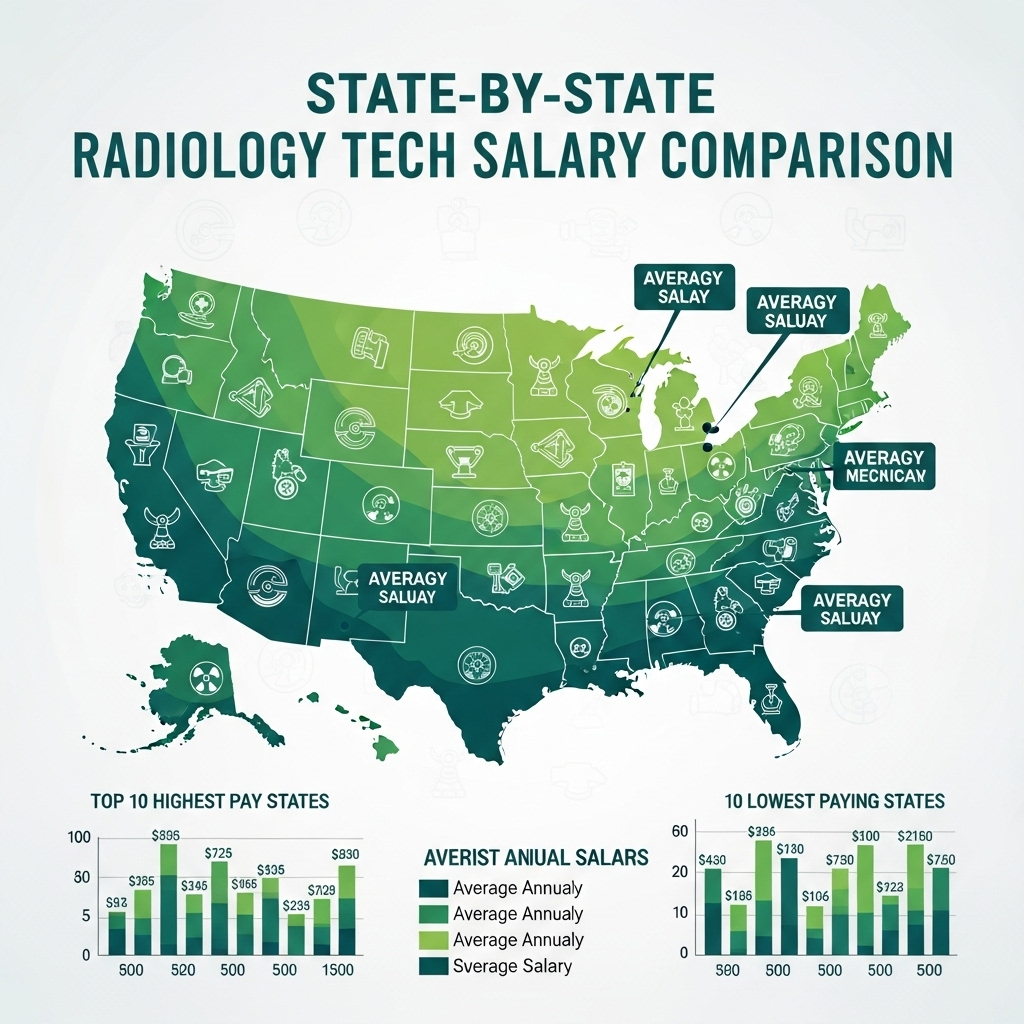
Highest Paying States
With average yearly salary frequently surpassing $80,000, California is one of the highest-paying states for radiology technologists. These high pay levels are a result of the state’s high cost of living and concentration of healthcare institutions.
Although the higher pay frequently comes with higher living expenditures, radiology technicians can also expect above-average pay in Massachusetts, New York, and Hawaii.
An intriguing example is Alaska, which offers high wages to entice medical experts to underprivileged regions. Some jobs even come with other incentives, such as housing allowances.
States with Competitive Middle-Range Salaries
Compared to the highest-paying coastal states, states like Texas, Florida, and Illinois offer Radiology Tech Salary good pay prospects and more affordable living expenses.
Because of their extensive healthcare systems and variety of medical facilities, ranging from local community hospitals to big medical centres, these states frequently offer excellent professional growth prospects.
In these markets, radiology technicians may have more effective purchasing power due to the combination of good pay and reduced living expenses.
Emerging Markets and Growth Areas of Radiology Tech Salary
The need for Radiology Tech Salary is rising in several jurisdictions as a result of ageing populations and the growth of healthcare systems. Employment in the healthcare industry is increasing in states like Arizona, North Carolina, and Tennessee.
As healthcare organisations keep improving their imaging capabilities, these markets can provide competitive beginning salaries and great potential for promotion.
In order to draw in skilled technologists, rural regions in different states may provide special compensation packages that include sign-on bonuses, loan forgiveness plans, and extensive benefits.
Proven Strategies to Increase Your Earning Potential
Pursue Advanced Certifications
One of the best strategies to raise your radiology tech pay is to obtain specialised credentials. You can negotiate pay and open up new employment options with each modality you learn.
Sarah, a five-year-experienced radiology tech, is a perfect example of how successful this approach works. She got a job at a speciality imaging facility after earning her MRI certification, and her pay increased by 20%. Six months of study and clinical rotations were necessary for the additional training, but the investment was recouped within the first year.
Interventional radiology, CT, MRI, and mammography are popular high-value certifications. Although each speciality calls for particular education and testing, they usually lead to instant pay increases and long-term professional benefits.
Gain Strategic Experience of Radiology Tech Salary
While experience on its own boosts earning potential, strategic experience in fields with strong demand more efficiently speeds up wage growth.
Make an effort to become familiar with sophisticated imaging techniques and intricate processes. Volunteer for difficult cases and look for chances to use state-of-the-art machinery.
Being cross-trained in several modalities increases your employability and gives you negotiating power over pay. Many prosperous radiology technicians consciously develop proficiency in two to three related fields..
Consider Geographic Relocation
Your pay trajectory may be significantly impacted by a strategic move. Mark’s tale is a great example of this strategy. He chose to move to California, where there is a constant need for imaging specialists, after working as a radiology tech in a remote location. In California, his starting pay was 30% more than in his prior job, and there were also a lot more prospects for career progression.
Examine markets with favourable salary-to-cost-of-living ratios and a significant demand for radiology techs. To entice talented experts, several places provide sign-on bonuses or relocation aid.
Think about taking temporary or travel tech jobs as a means to get premium compensation while exploring new markets. Compared to permanent roles, many travel jobs pay 20–40% more.
Master Salary Negotiation
Negotiating well can have a big impact on your pay without necessitating relocation or new training. This idea is illustrated by Lisa’s experience. With ten years of experience, she meticulously documented her dedication to ongoing education and her history of great patient outcomes in order to prepare for a pay review. She was able to negotiate a 15% pay rise by presenting this proof.
Use a variety of sources to investigate current market rates for your position and level of experience. Keep a record of your accomplishments, new duties, and any cost-cutting measures you’ve taken.
Be ready to properly explain your value offer and practise negotiating. A lot of technologists undervalue themselves and pass up chances to get paid more.
Pursue Continuous Education and Leadership Opportunities
Obtaining more formal education than is necessary can lead to prospects for growth and higher-paying jobs.
A bachelor’s degree in healthcare administration, radiologic sciences, or a similar discipline would be worth pursuing. Advanced degrees are preferred or required for many managerial and supervisory roles.
Look for leadership positions in your present company, such as department committee member, clinical teacher, or coordinator of quality assurance. These experiences enhance your résumé and frequently result in higher pay.
Participate in professional associations, give presentations at conferences, and keep up with changes in the field. These pursuits show dedication to one’s career and may provide doors to networking.
Explore Travel and Contract Opportunities
Jobs as a travel radiology technologist frequently come with excellent benefits packages that can greatly increase your yearly income.
In addition to paying 20–40% more than permanent jobs, contract jobs frequently come with extensive compensation packages, housing allowances, and travel reimbursements.
Your skills and marketability are improved by these opportunities, which also expose you to other healthcare systems, technology, and practices.
Future Outlook for Radiology Tech Careers
Job Growth Projections
Radiology Tech Salary employment is expected to expand by 6% between 2022 and 2032, which is faster than the average for all occupations, according to the Bureau of Labour Statistics. An ageing population that needs more medical imaging services is the main driver of this expansion.
Technological developments in imaging tools and processes keep opening up new career paths for qualified technologists. Rather than taking the place of human specialists, artificial intelligence and sophisticated imaging methods are broadening the range of radiology services.
Emerging Specializations
Opportunities for specialisation are frequently created by new imaging technology and methods. Specialities such as emergency imaging, paediatric radiology, and cardiac imaging are constantly developing and can pay well.
Traditional radiography and other healthcare responsibilities are increasingly being combined in hybrid professions, which usually offer better pay packages.
Technology’s Impact on Compensation
Instead than taking jobs away from radiology techs, new technology is opening up new jobs for people who are willing to keep learning. Professionals who keep up with new technology and get training that is useful for their jobs are more likely to get the best-paying jobs.
Digital imaging, artificial intelligence integration, and advanced visualisation techniques all need professional technologists that know a lot about both technology and medical care.
Frequently Asked Questions of the Radiology Tech Salary
What is the starting salary for a new radiology tech?
Radiology technologists who are just starting out usually make between $45,000 and $52,000 a year, depending on where they work and what kind of facility they work at. New graduates in places with high living costs might start at $55,000, while those in rural areas might start at $42,000.
How much can experienced radiology techs earn?
Radiology techs with 5 to 10 years of experience usually make between $60,000 and $80,000 a year. People with specialised certificates or in leadership roles can make $85,000 or more, especially in big cities where there is a lot of demand for their skills.
Which radiology tech specializations pay the most?
MRI technicians, CT technologists, and interventional radiology experts usually make the most money, sometimes $70,000 to $90,000 or more a year. Radiation therapists and nuclear medicine technologists also make a lot of money.
Do radiology techs receive good benefits?
Most jobs as a Radiology Tech Salary come with a full benefits package that includes health insurance, retirement contributions, paid time off, and help for continuing education. Many healthcare organisations also pay for school and give employees chances to learn new skills.
How long does it take to become a radiology tech?
It usually takes 1 to 2 years to finish a radiology technology program. Most associate degree programs take two years to finish, while most certificate programs can be finished in 12 to 18 months. Specialised certificates take more time.
Is the radiology tech field expected to grow?
Yes, the BLS says that the number of radiologic technologists will expand by 6% through 2032, which is faster than usual. Imaging services are still in high demand since the population is becoming older and medical technology is getting better.
Maximizing Your Radiology Tech Career Potential
The pay for Radiology Tech Salary is really good for people who are ready to put money into their professional growth. The field has obvious paths for income growth, with entry-level jobs starting at about $45,000 and specialised jobs paying more than $90,000.
Strategic career planning is the key to making the most money you can. Pursue relevant certifications, gain experience in high-demand specializations, consider geographic factors in your career decisions, and don’t underestimate the power of effective salary negotiation.
Sarah, Mark, and Lisa’s stories show that you can get big raises if you work hard and plan strategically. There are many strategies to get a better salary, such as specialising, moving, or negotiating well.
As healthcare technology gets better and the population gets older, there will always be a need for trained radiology techs. People who keep up with changes in the area and keep improving their skills will be in a good position to get the highest-paying jobs in this lucrative field.
Begin by looking at your existing talents and figuring out what you need to work on. Find out what the average salaries are in the markets you want to work in, and then make a strategy for your professional growth that fits with your career goals. You will see a return on your investment in your Radiology Tech Salary profession for years to come.


